
Caldecott Critique: NAVIGATING NIGHT by Julie Leung and Angie Kang (+ Giveaway)
Claude Monet, Ezra Jack Keats, and Michael Jordan with his eyes closed.

I will now present this book as if I was a member of the 2027 Caldecott committee . . .
Click here for the official Caldecott Medal Terms and Criteria
Click here for previous Caldecott Critiques
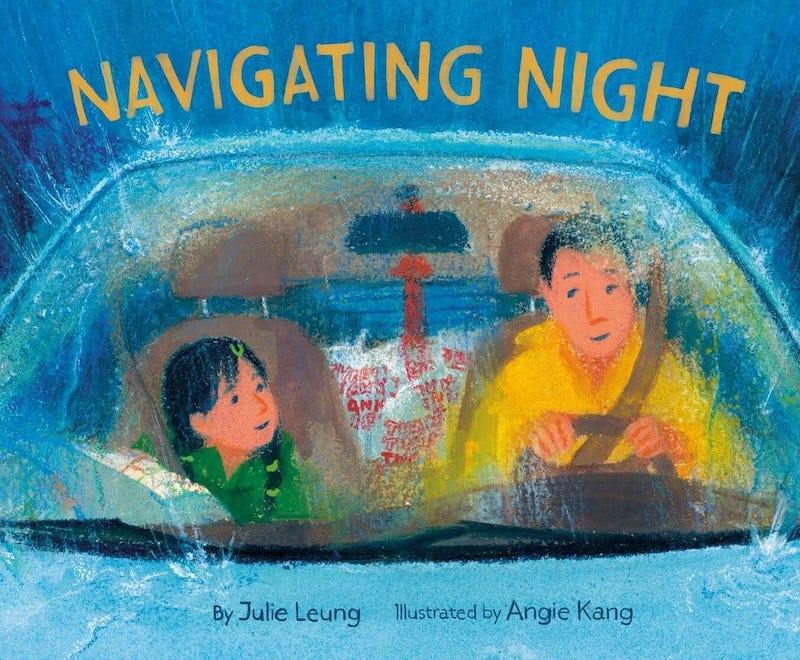
Hello fellow committee members, or co-mems, as I like to say.
Raise your hand if you like the co-mems thing.
Okay, sticking with the full “committee members” from now on. NAVIGATING NIGHT, illustrated by Angie Kang and written by Julie Leung, is one of the most distinguished picture books of the year.
While I could begin by talking about the front cover . . .
*Dramatically removes dust jacket*
. . . Let’s begin with a different kind of cover. The case cover . . .
*Assembled committee members audibly gasp, as they’ve never seen such an unexpectedly cool move to begin a book presentation. They feared this committee might be a little dry, but are realizing it could potentially be full of people doing sick moves like this*
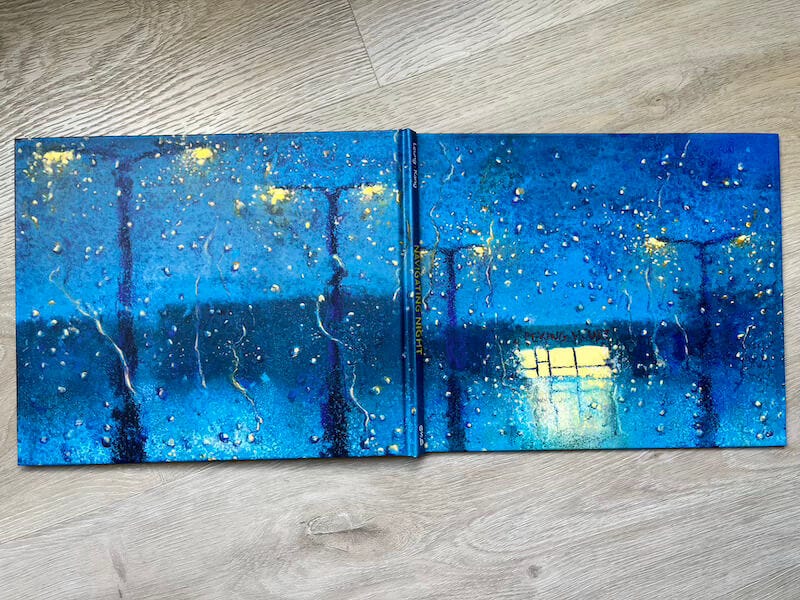
I’d put this up there with any of the finest works of impressionistic art.
Me: I’d like you to take down Claude Monet’s La Grenouillère to make space for Angie Kang’s NAVIGATING NIGHT case cover art.
Museum Curator: Oh! Uh, okay! Who are you?
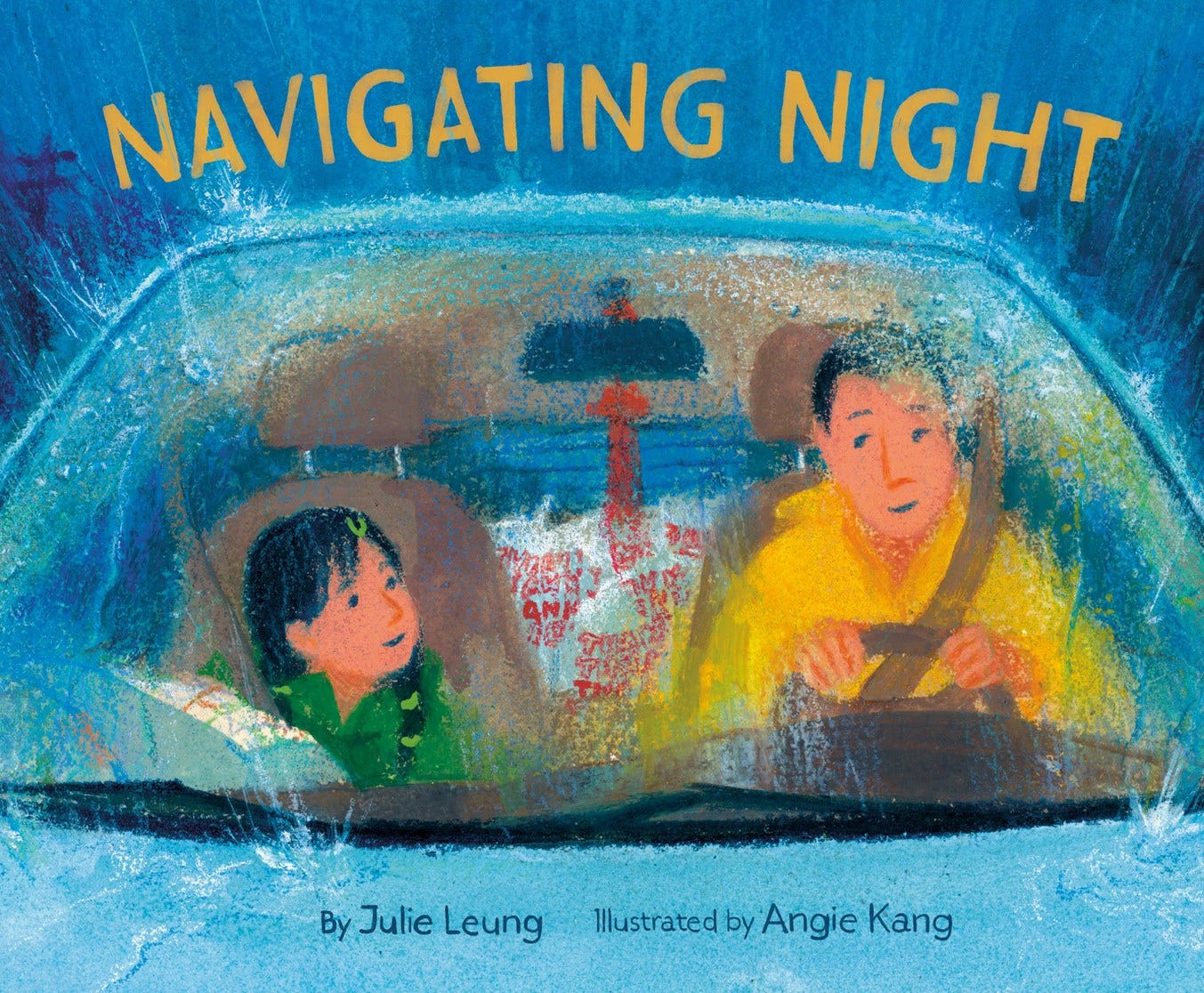
One thing that’s important to recognize, and something that I think really elevates this already insanely accomplished illustration: This isn’t a scene of a rainy Peking House parking lot, it’s a scene of a rainy Peking House parking lot as seen through glass - see the beads and rivulets of water? This is the perspective of someone looking through a window. A minivan window. Someone we’re about to meet.
But first: endpapers!
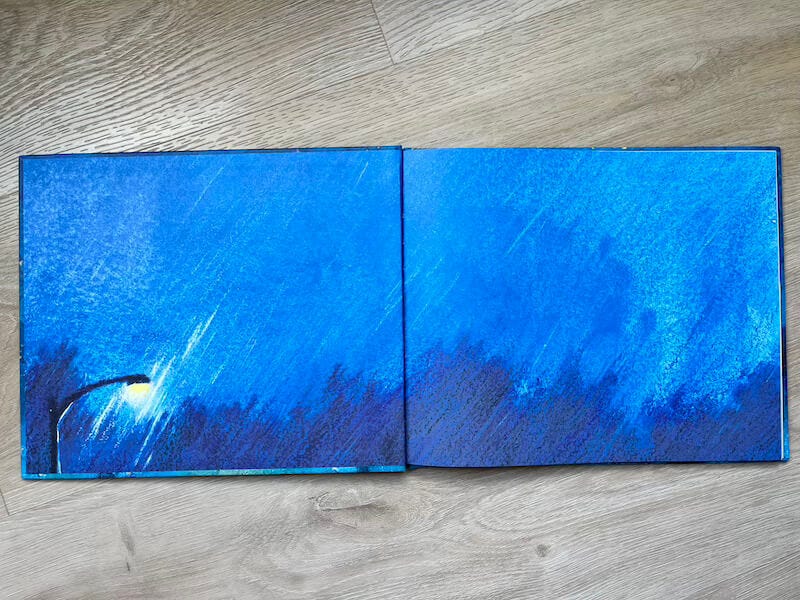
Now this is a rainy parking lot scene, but it focuses on the sky, where we see dark clouds. When I say delineation, you say setting!
Delineation!
I said . . . delineation!

Setting. You’re supposed to say setting. Delineation of setting.
Not fans of call-and-response. Noted.
Anyway, speaking of notes, remember these front endpapers setting the scene - we’ll compare them with the back endpapers in a little bit.
On to the title page, which is subtly doing a lot of work.
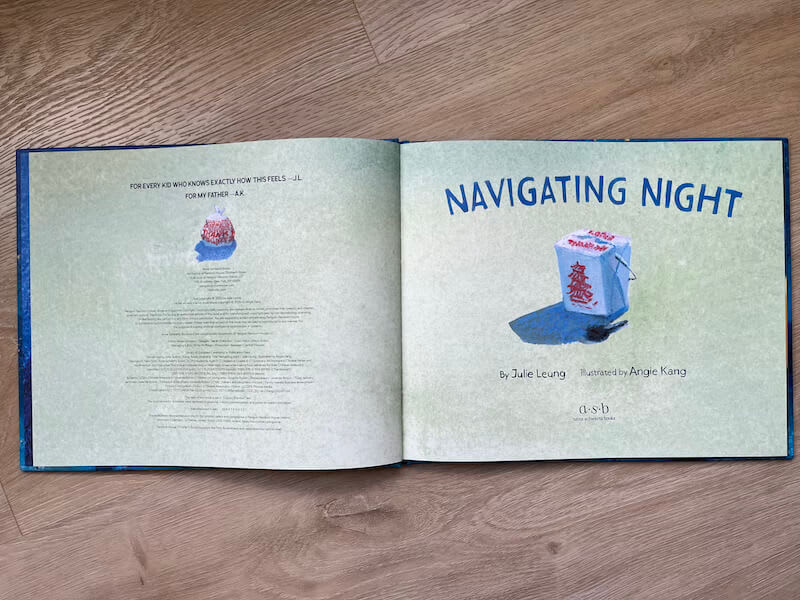
This spread (and the case and endpapers before it) is a perfect example of how Angie Kang uses every single opportunity to add detail that builds the world of this story. The Caldecott criteria calls it “collective unity of story-line”, and it’s evident throughout.
On the left side: accompanying the dedication is an illustration of the iconic THANK YOU bag. Chinese takeout is often delivered in this kind of bag, so the placement here acts as foreshadowing, and also as a literal THANK YOU. Because that’s what a dedication is.
Over on the title page - the takeout container and plastic spork. It’s like we’ve dug into the bag on the left and pulled this out and set it down on the right. It’s a sequential progression that does a bit of world building and also generates some forward momentum.
And that continues after the page turn:
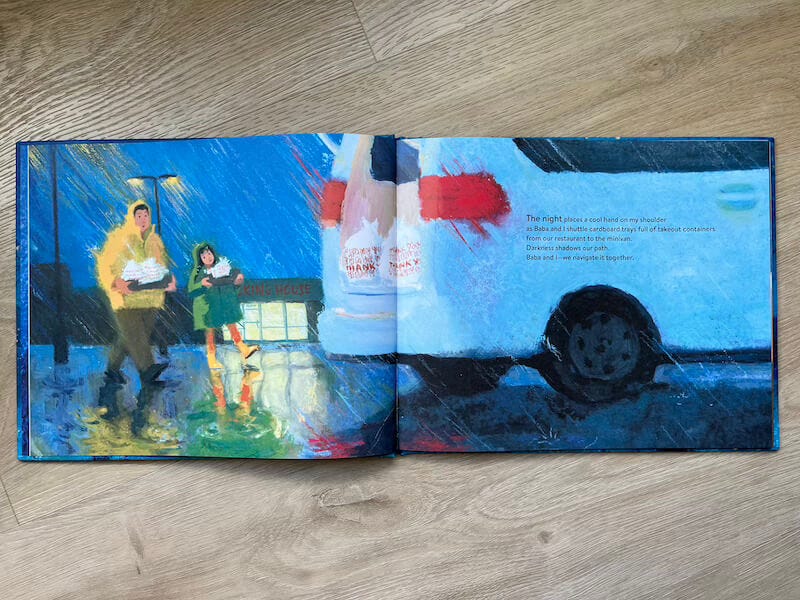
Officially kicking things off with a two-page, full-bleed spread. In an instant we know our characters and their objective. The girl and her father (“Baba”) are walking to the right (which is usually the direction of progress in picture books) arms loaded with fresh deliveries. The van is also pointed right, extending off the page, urging the reader toward the page turn (“Excellence of presentation in recognition of a child audience”). This scene is full of potential energy.
Can we talk about the choice to set this story during a downpour? Because this ups the level of difficulty by a lot. Kang’s depiction of rain in this book is a significant achievement (per the criteria, one of the defining qualities of a distinguished book). It’s like when Michael Jordan made that free throw with his eyes closed: Michael didn’t have to do that, but that fact that he did is an indication of excellence.
But unlike Jordan, Kang’s artistic flex also serves a greater purpose. As she mentions in her illustration note at the end of the book, this stormy weather also allows for more storytelling depth and visual metaphors (rain = stormy relationship between father and daughter).
The page turn reveals a study of reflections.
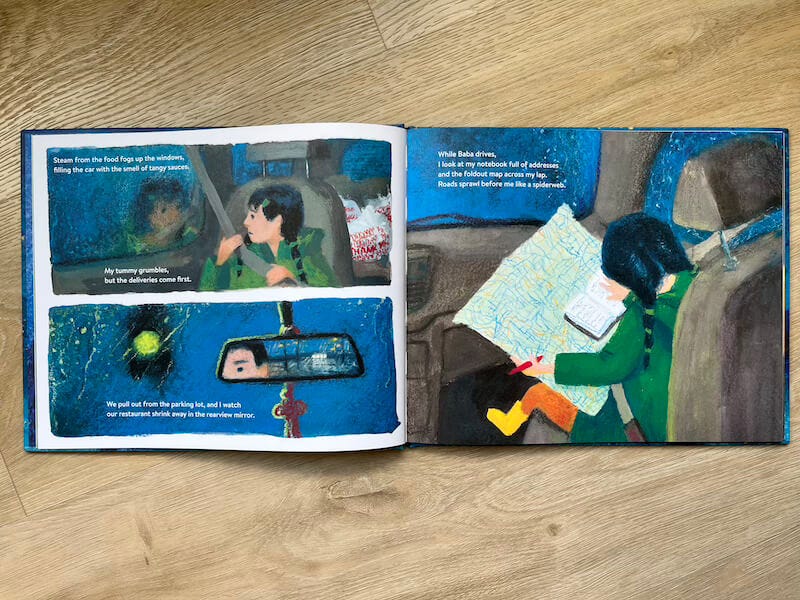
The girl looks out the window, only to see her dissatisfied face reflected back (delineation of character and mood, nicely contrasting with the cheery THANK YOU bags behind her). In the bottom image we see 1) the green light through the windshield, 2) the father’s reflection in the rear view mirror, and 3) the restaurant receding into the distance. It’s a complex composition, executed seamlessly (“Excellence of execution in the artistic technique employed”).
On the next page, the reflections continue.
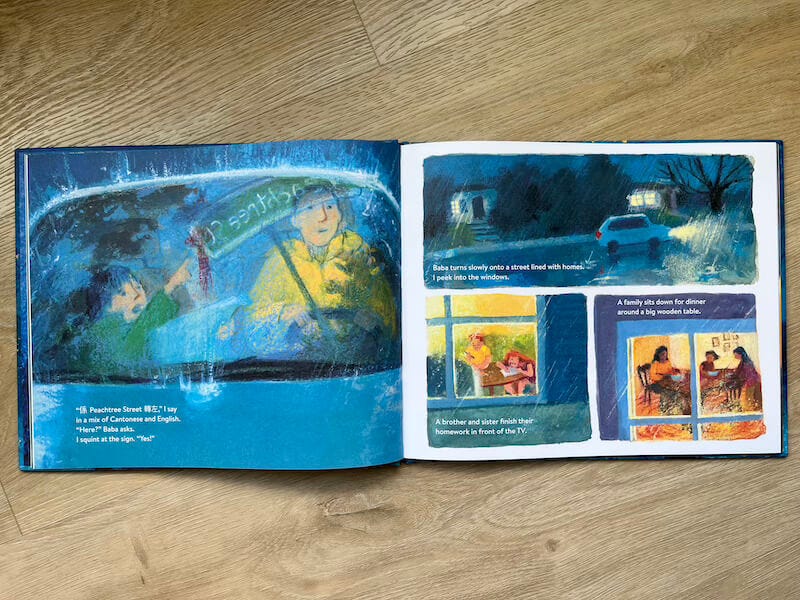
The girl points and the reflection shows where: the street sign.
The art for this book was created with a word I will someday learn to spell without looking: gouache. Also crayon, colored pencil, and pastel. Kang sprinkled salt on wet paint to assist with the rain texture.
It’s time to make the first delivery.
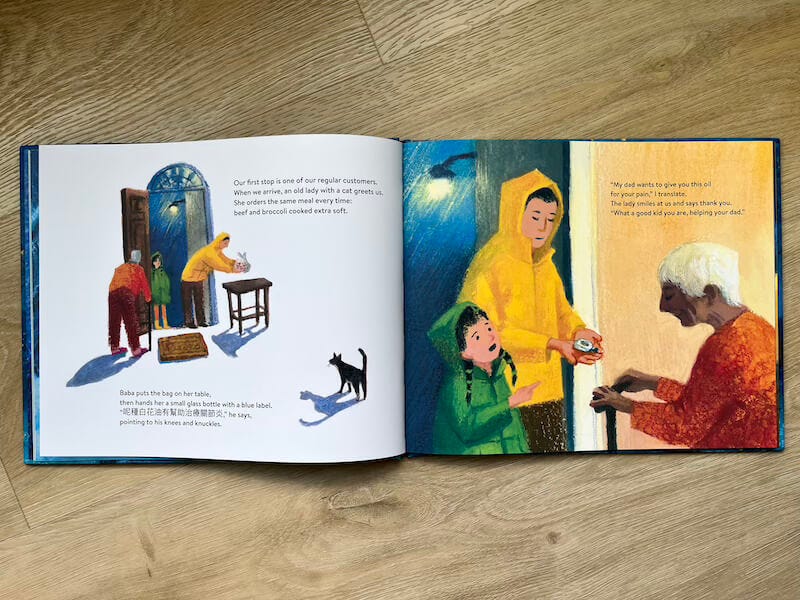
Negative space, perfectly deployed. After pages of dark blues, the bright white interior is almost blinding. The father bends to set down the food, breaking the boundary between outside and inside. The feeling of being in someone else’s space is palpable.
But, fellow committee members, everything we’ve discussed thus far has been a precursor to the next spread, which is my favorite of the whole book . . .
I’m giving away a copy of NAVIGATING NIGHT. Just restack this post and you’re entered to win.
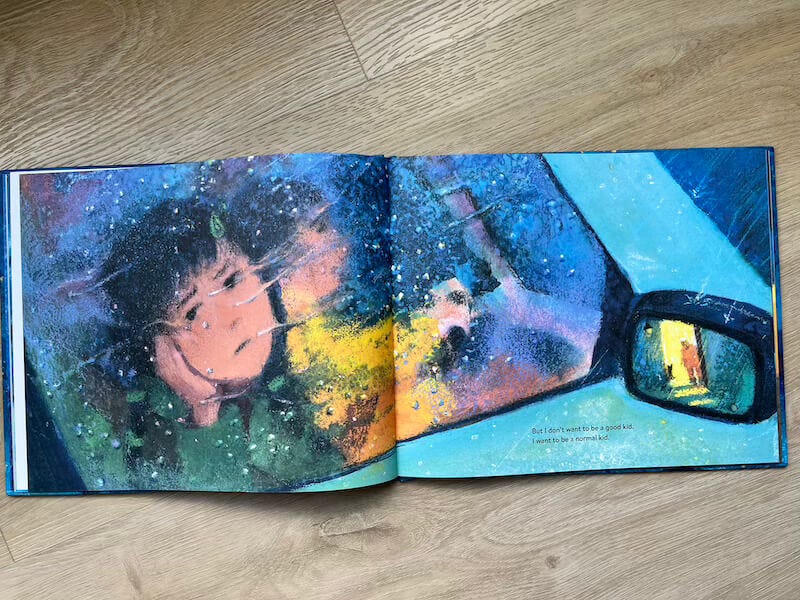
I could really go on all day about just this illustration.
Me: Okay, small request. I’d like you to move that case cover art over a few feet and hang this piece up next to it.
Museum Curator: Did you say you know the owner, or something?
Excellence of execution, excellence of pictorial interpretation, appropriateness of style - this one image is playing Caldecott criteria bingo. The girl’s expression, hid from the father (but not from the audience). The rear view mirror looking back as the pair continue their deliveries. That’s it, I’m submitting this spread for the New York Times 10-Minute Challenge.
There’s also something subtle going on with how the art is conveying the mood. Almost every image leading up to this one has been “level”. But here, the perspective is tilted - see the angle of the car door? If Molly Bang has taught me anything, it’s that this tilt can indicate dynamic movement, but also discomfort, which begins to simmer on the next spreads.
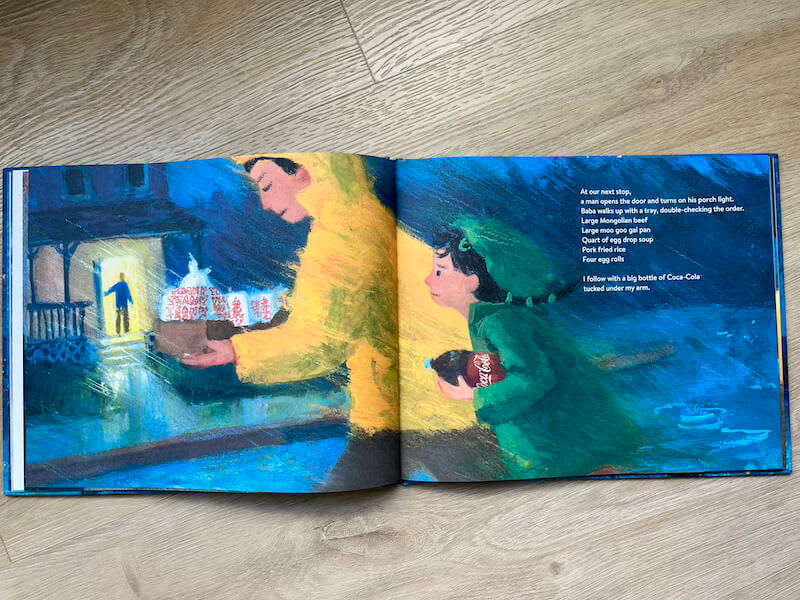
Things are not right. The perspective remains tilted - see the lines of the curb and house. The characters have now turned back to the left. This isn’t progress - this is stagnation. It heightens the sense that this delivery run will never end. The gutter separates father and daughter, implying a growing tension between the two. Everything here is contributing to the delineation of mood.
This spread reminds me of some of the best Ezra Jack Keats illustrations (specifically A LETTER TO AMY and GOGGLES!) - brimming with texture, movement, and emotional impact.
Then things get uncomfortable.
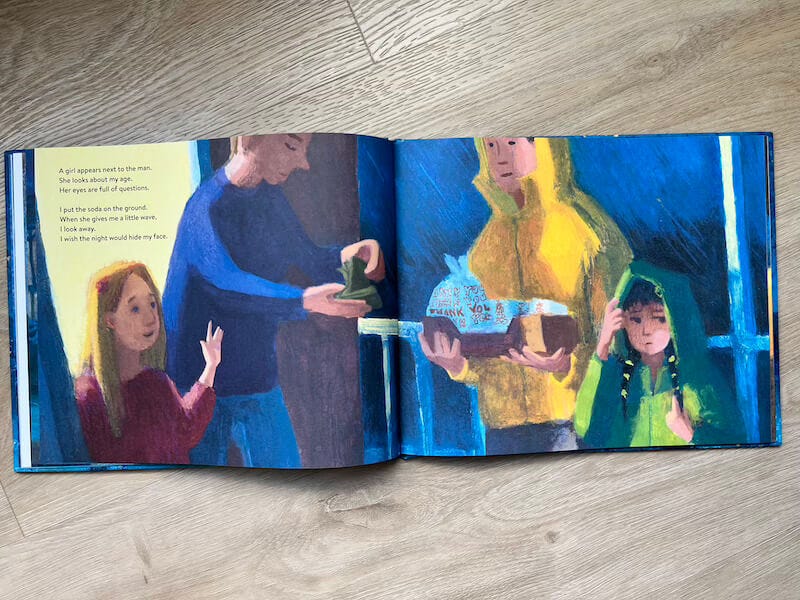
The placement of the characters across the gutter from each other - a near perfect mirror image - says it all: in the same place physically, yet worlds apart. The girl, hood up and glancing to the side, speaks volumes.
On the next spread, things boil over.
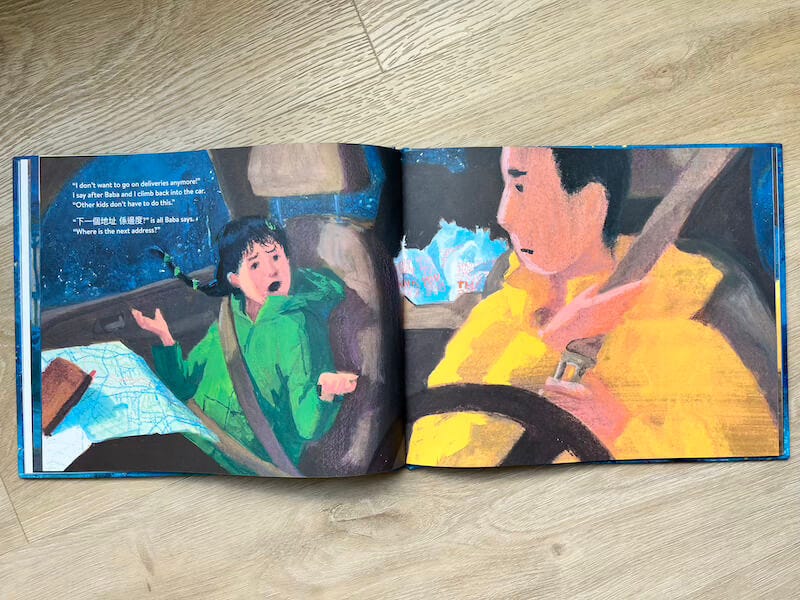
Notice how the perspective heightens this tense moment. It’s a great example of “Excellence of pictorial interpretation of story.” The girl snaps (and snaps her head - as indicated by the flying hair). Dad is in the foreground, exaggerating his size. The girl, further away from the viewer, appears small. In this moment, she’s finally letting her true feelings be known and it feels like she’s one inch tall shouting at a giant. And probably just as scary.
Then things take a turn.
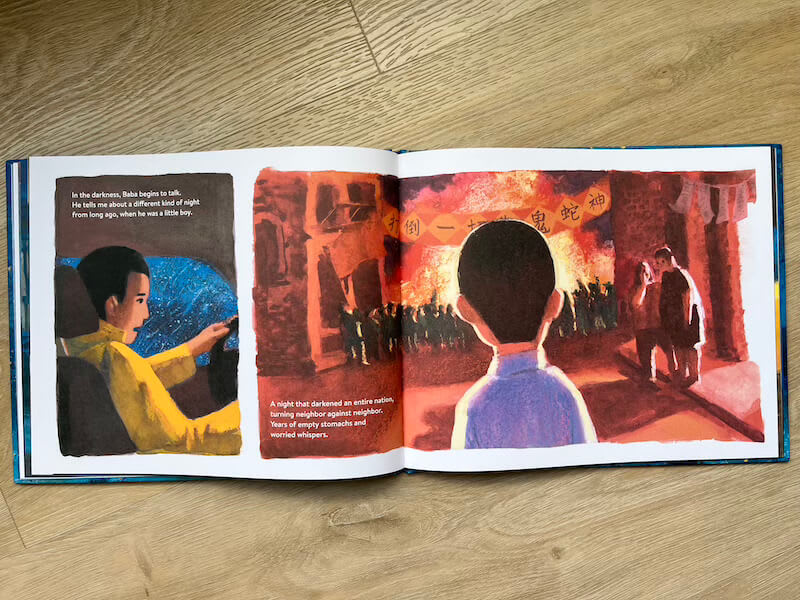
The father opens up, and a vivid memory comes flooding back. It spills over the gutter and threatens to overtake the whole spread. Dad faces right - looking at the memory just like the reader is. A red color palette wordlessly signals a mood shift. This is a memory full of unrest.
The illustrator note informs us that Kang drew on family experiences during the Chinese Cultural Revolution to verify details in the art. The image is from behind the father as a boy, a smart move which essentially puts the reader in his shoes. We’re not just looking at someone else’s memory - we feel like we are there.
On the next page, the memory continues. But then something interrupts Baba’s recollection:
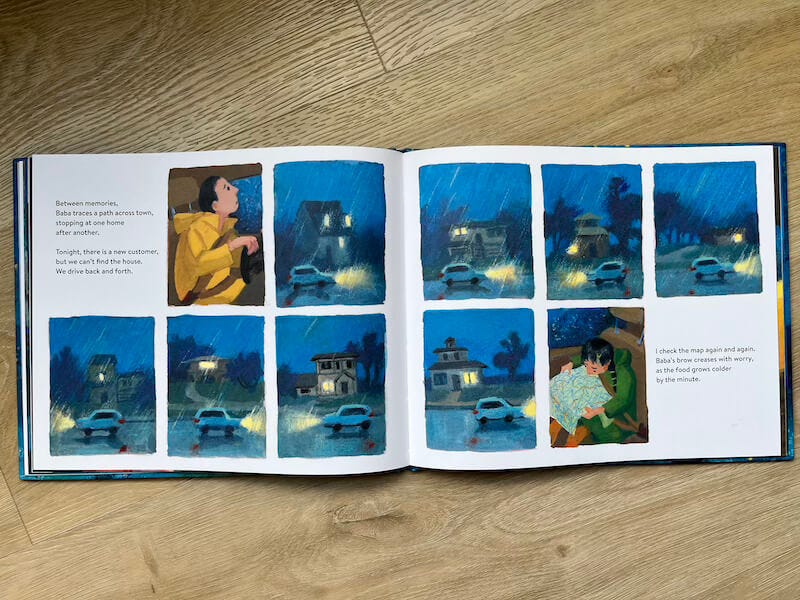
They can’t find the dang house. Dad and girl are placed as far away from each other as possible - on either end of a string of vignettes emphasizing the passing of time, and making the reader feel what the characters are going through - the frantic search for looking for something you’re in a hurry to find. When every lost moment feels like an eternity. This is some “Excellence of pictorial interpretation of story” right here.
Finally, the search is over.
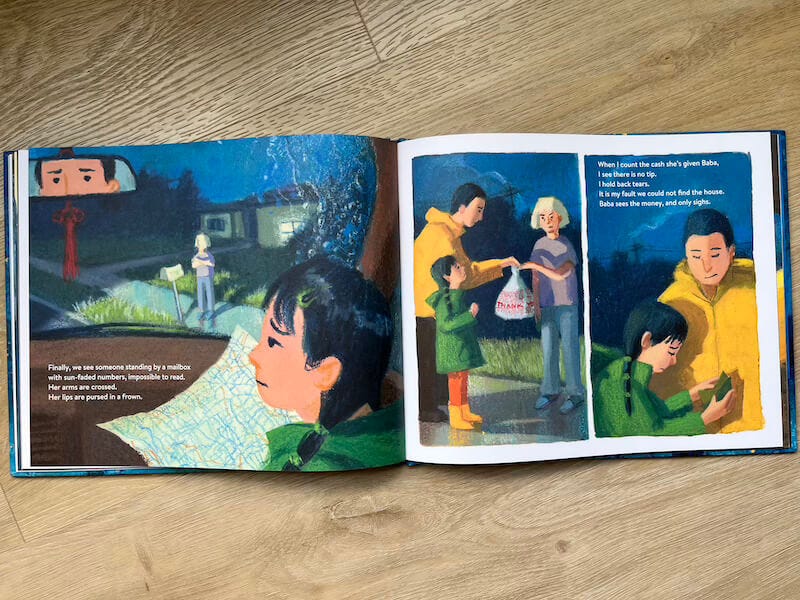
We see the girl’s expression directly but - cleverly - the mirror allows us to see the father’s as well. They match. On the right side, the girl and her dad are shown on the same side of the spread again, bonded in their shared disappointment.
The next two spreads return to the father’s memories of making the trip to America (and the red color palette).
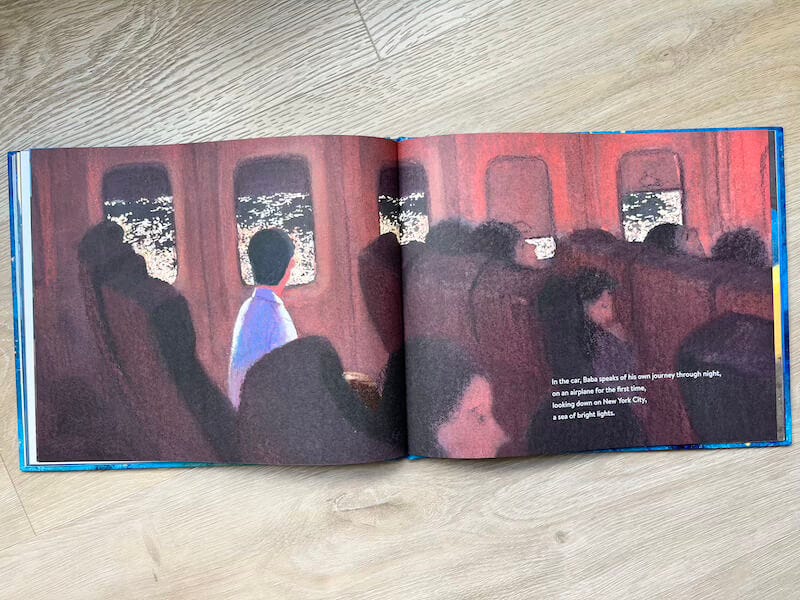
Notable here is the delineation of theme and mood - isolation and unease. He is literally the only human on his side of the spread.
The next spread continues the memory. It’s key to the story, but I’ll jump over it here because am I really going to write WAR & PEACE about every single spread???
Suddenly, we’re back in the car, but the tone has shifted.
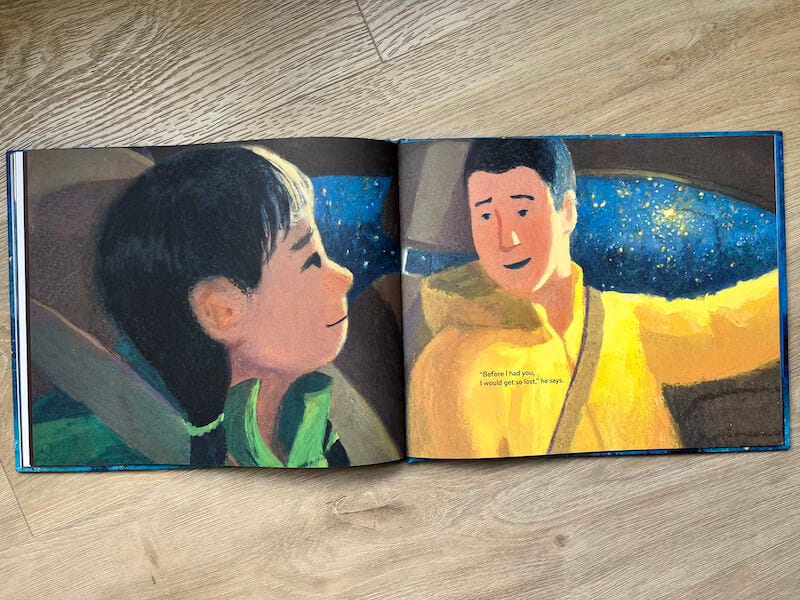
Compare this to the “argument” spread earlier - the perspective has flipped. Now the girl is in the foreground, looking larger than her father. The tension has eased. The girl no longer feels one inch tall.
Then the words fall away for a moment.
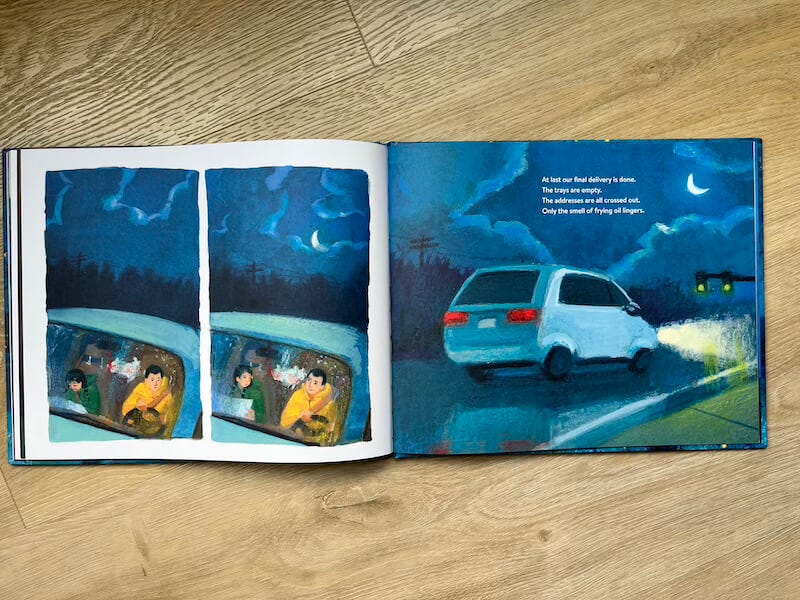
Two vertical panels show a meaningful look between father and daughter. The clouds above begin to part. The right side now shows the minivan full speed ahead. The moon is out, the rain is stopping, and the light is green - all visual clues that indicate a positive shift in the mood of the story.
They’re heading back to where they began. I’m going to jump ahead to the final spreads of the book.
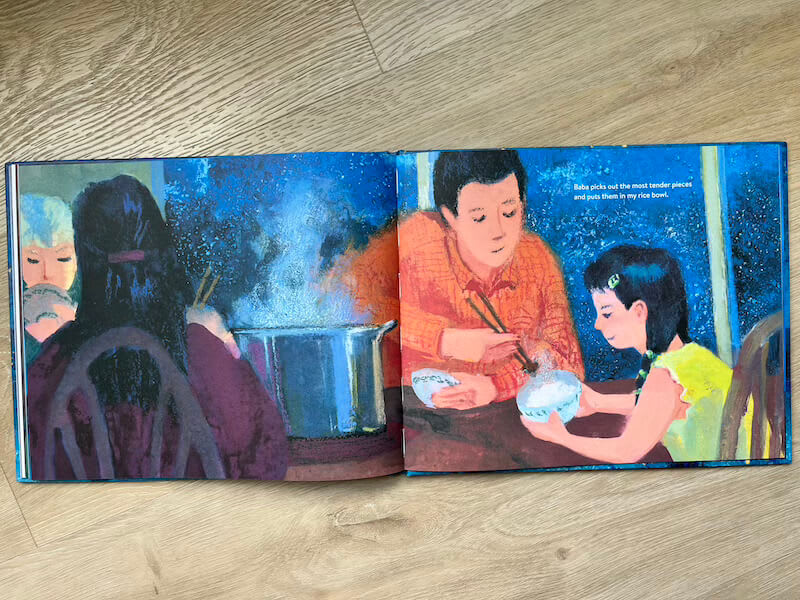
They made it back to the Peking House, and have joined the rest of the family for a meal. As the family members are busy eating, the audience sees a moment of care and love as Baba “picks out the most tender pieces” and gives them to his daughter. They are unified on the same side of the gutter.
One last spread.
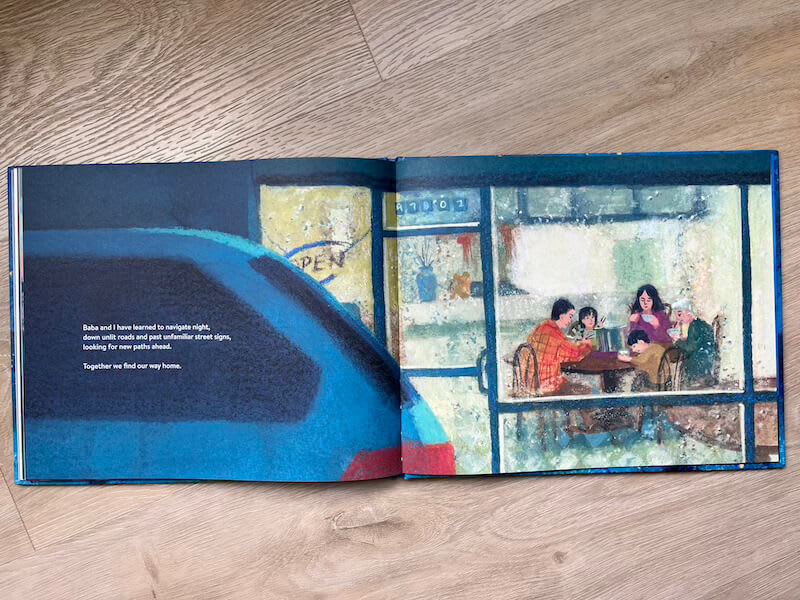
It acts as a recap of the whole story. We see the minivan in the foreground, and through the window, Baba, the girl, and their family share their meal inside the restaurant. This sort of “visual recap” speaks to NAVIGATING NIGHT’S “Excellence of presentation in recognition of a child audience.” It reminds me of a “what did you do today” conversation you’d have with a kid. And here are all the elements in one spread.
The page turn reveals the final endpapers:
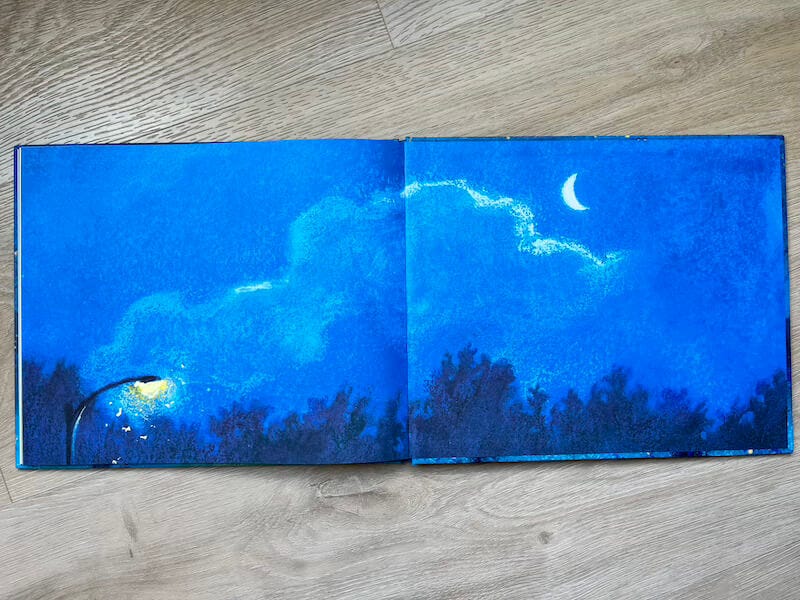
The weather, like the central relationship in the book, has cleared.
Fellow Caldecott committee members, we have a lot of books to consider, but NAVIGATING NIGHT is surely one of the most distinguished of the year.
PSST! I have some off-the-record thoughts - things that aren’t in the Caldecott criteria (and that I DEFINITELY wouldn’t say when presenting the book to the committee), but things that will likely be floating around in the committee members’ subconscious that could determine if this book wins a Caldecott. I’m sharing them with paid subscribers below.
Will the 2027 Caldecott committee discuss the things I’m about to mention? No. Would someone get completely ostracized in the room if they even brought them up? Yes! But nevertheless I believe they play a role.